
SaaS teams · AI spend
The AI bill nobody owns: seats, credits, API keys and the corporate card
Ask a founder of a 60-person SaaS company what it spends on AI for engineering and you will usually get a pause. There is the coding-assistant plan. There are a few personal subscriptions on expense reports. There is an API key someone created for an agent experiment, and a cloud invoice with a new AI line. Each one has an owner. The total does not.
Nythrex team · 10/29/2026
In brief
6-minute read · For founders, CTOs and finance · 29 October 2026
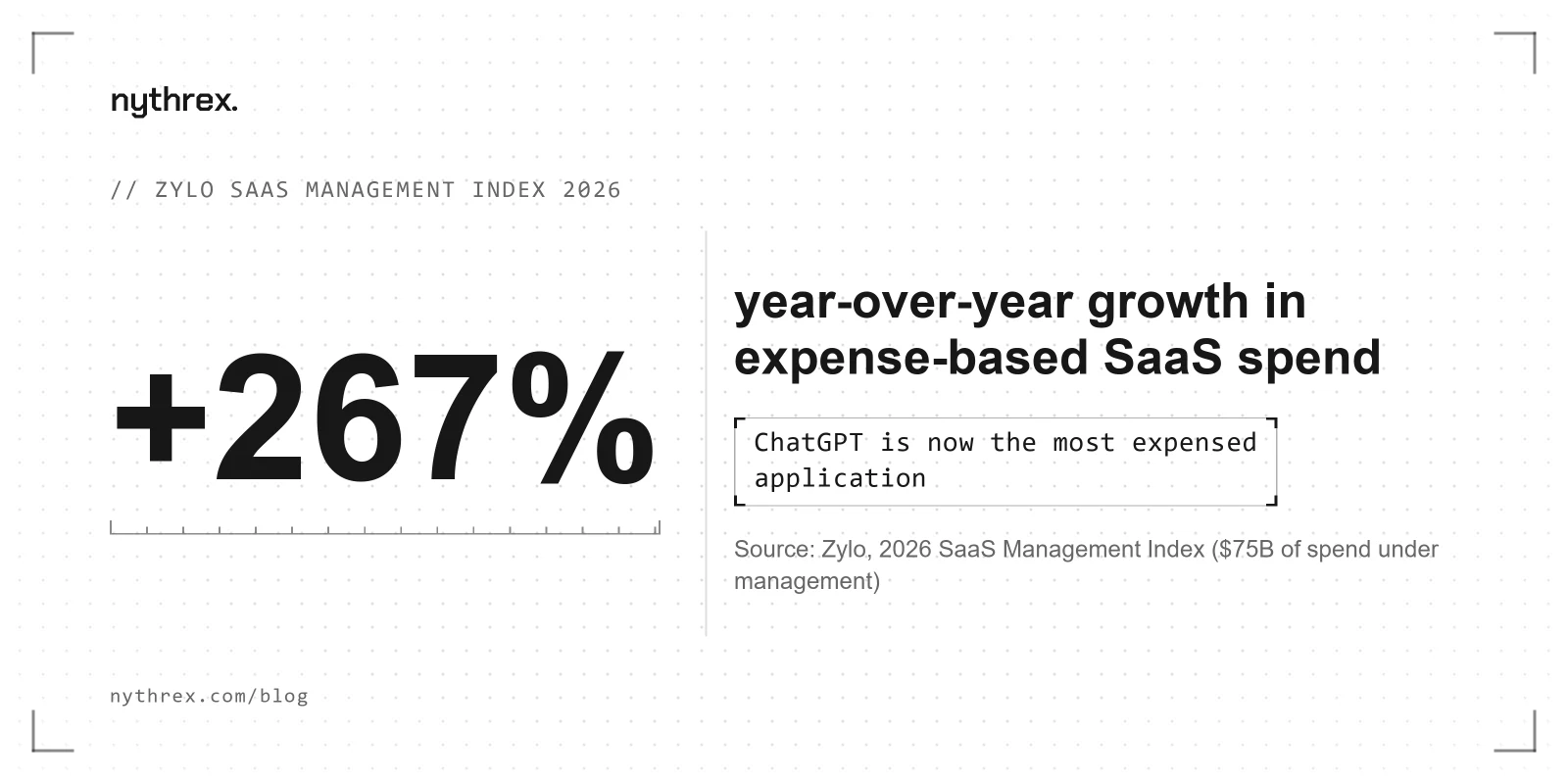
- Expensed software is exploding. Zylo found expense-based SaaS spend up 267% in a year, with ChatGPT now the most expensed application.
- Surprises are the norm. 78% of IT leaders reported unexpected charges tied to consumption-based or AI pricing in the past 12 months.
- Control sits outside IT. Business units control 81% of SaaS spend; IT directly manages 15%.
- The fix is an owner, a project for every AI cost and one view that puts seats, usage and cloud together.
Four doors AI comes through
Seats
Coding assistant plans per developer. Predictable, until the plan switches to usage-based credits, as GitHub Copilot did in June.Usage and credits
Agent runs and chat billed by tokens. The cost depends on the model and the task, not on head count.API keys
Keys created for experiments, scripts and internal tools. Often on one person’s account and one shared invoice.Expense reports
Personal subscriptions reimbursed monthly. Invisible to engineering, visible to finance only as a vendor name.
By the numbers
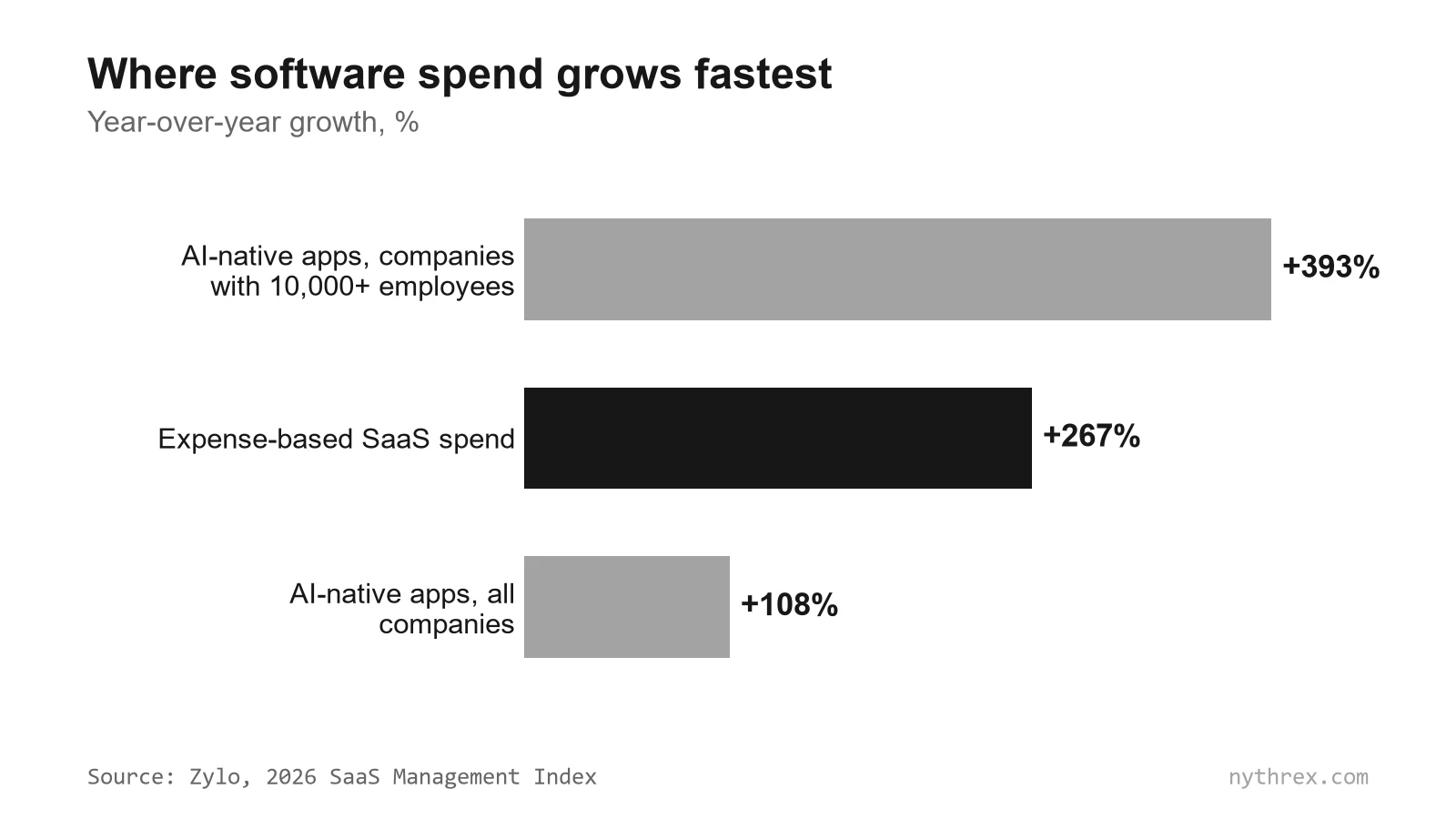
Zylo’s index, built on more than $75 billion of spend under management, shows where the growth is. AI-native application spend rose 108% overall and 393% in companies with more than 10,000 employees. Smaller companies feel the same pattern with fewer people to watch it.
78%
of IT leaders saw unexpected charges from consumption-based or AI pricing in the past year.61%
were forced to cut projects because of unplanned SaaS cost increases.36%
of SaaS licences are left unused on average.
Why nobody owns it
| Role | What they see | What they miss |
|---|---|---|
| Finance | Vendor invoices and expense lines | Which product or project the money served |
| Engineering lead | Admin consoles of the tools they manage | Personal subscriptions and stray API keys |
| Developers | Their own usage, if anything | Any total at all |
| Founder | The card statement | Whether any of it shipped |
Every AI cost has an owner. The total doesn’t.
How to take ownership in a month
- 1
Inventory every door
Pull seats from admin consoles, usage from provider accounts, keys from your secret store and subscriptions from three months of expense reports. - 2
Name one owner for the total
Usually the engineering lead, with finance as the second reader. One person answers the question “what do we spend on AI?” - 3
Give every cost a project
Products, client projects or internal platforms. Anything without a project stays visible as unassigned, not spread across the rest. - 4
Cap before you cut
Usage-based plans offer budgets. Set them per team or project before deciding which tools to drop. - 5
Review it next to delivery
A monthly total says little. AI cost next to what each project shipped says whether it is worth it.
Where Nythrex fits
Nythrex brings AI usage from Claude Code, Codex and GitHub Copilot together with CI and cloud, by project. AI spend that has no project stays on its own line. Usage on a subscription is labelled as an estimate from the price list, and a total with a missing price is marked incomplete rather than shown as zero.
Sources
Frequently asked questions
What is AI tool sprawl?
AI tool sprawl is when AI reaches a company through many separate channels: seat plans, usage credits, API keys and personal subscriptions on expense reports. Each has an owner, but no one sees the total or what it produced.
How fast is expensed AI spend growing?
Zylo’s 2026 SaaS Management Index found expense-based SaaS spend up 267% year over year, with ChatGPT the most expensed application, and AI-native app spend up 108%.
Who should own AI spend in a software company?
One person should own the total, usually the engineering lead with finance as a second reader. Each cost should belong to a product or project, with anything unassigned kept visible on its own line.
Read next
- The flat seat is over: GitHub Copilot now bills agent work by the tokenSince June 1, 2026, every GitHub Copilot plan meters chat and agent work in AI Credits at model API rates. What changed, what it means for engineering budgets, and how to keep the bill explainable.Read
- AI made your team faster. Is the client project more profitable?Agencies and software outsourcing firms are adopting AI faster than they can price it. Before you choose hourly, fixed or value-based pricing, you need one number most agencies do not have: what each client project really costs.Read
- Claude Code and Codex cost tracking by project and PRSee what Claude Code and Codex cost your team by project, person, pull request and period. One command per machine — no code, no prompts.Read
Stop guessing.
Start seeing.
No card and no subscription: paid plans have not launched yet.