
Agencies · Margins
AI made your team faster. Is the client project more profitable?
Every agency owner has had the same conversation with themselves this year. The team ships faster with AI. The client still pays by the hour, or a fixed fee agreed before anyone used an agent. So is the business earning more, or giving the gain away? Most agencies cannot answer, and it is not a pricing problem. It is a measurement problem.
Nythrex team · 10/29/2026
In brief
6-minute read · For agency and outsourcing leaders · 29 October 2026
- The discount wave has not arrived. In Productive’s March 2026 survey of 174 agencies, clients had not increased the rate of asking for discounts.
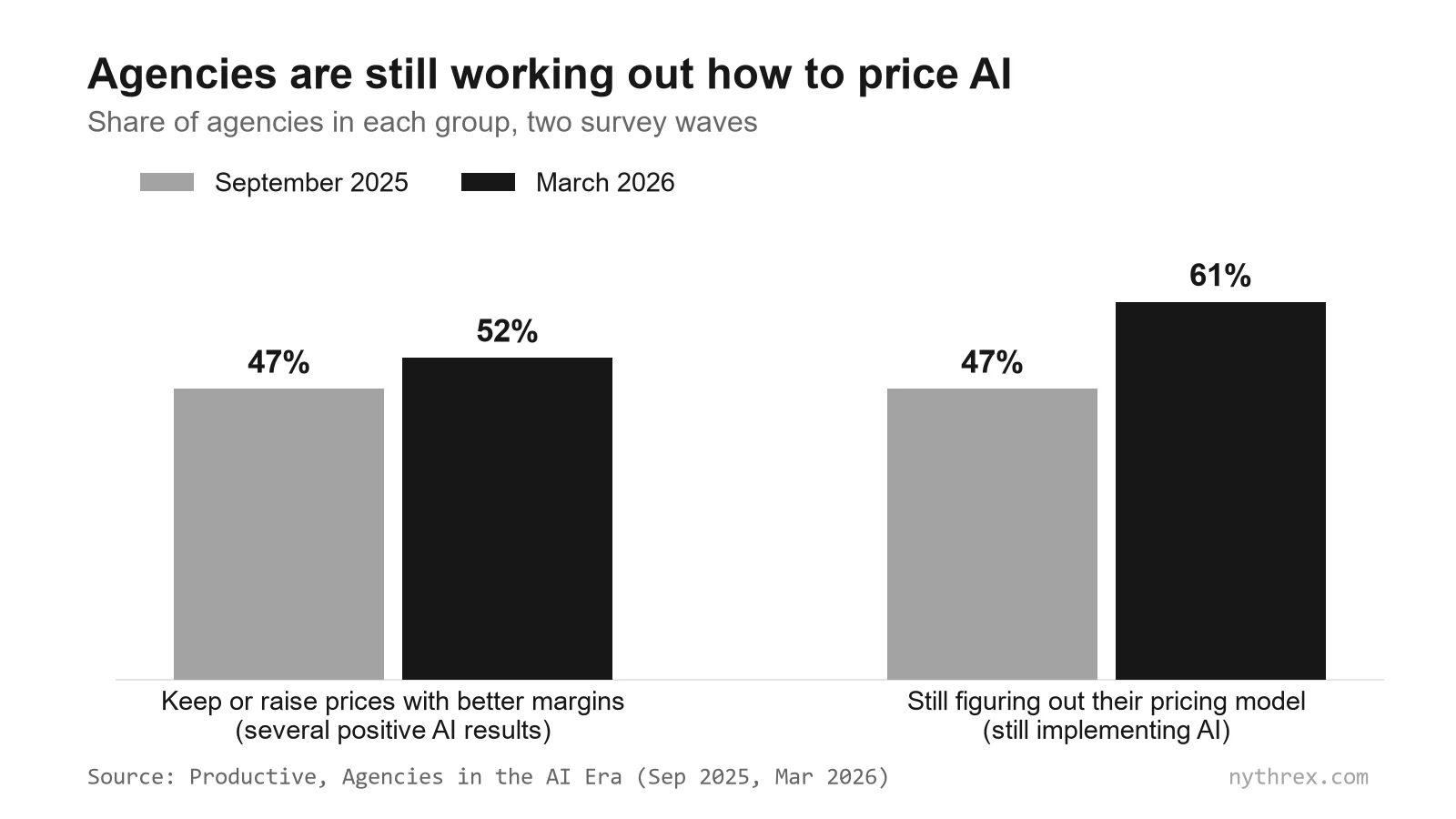
- Pricing is still unsettled. Among agencies still implementing AI, 61% are still figuring out their pricing model, up from 47% six months earlier.
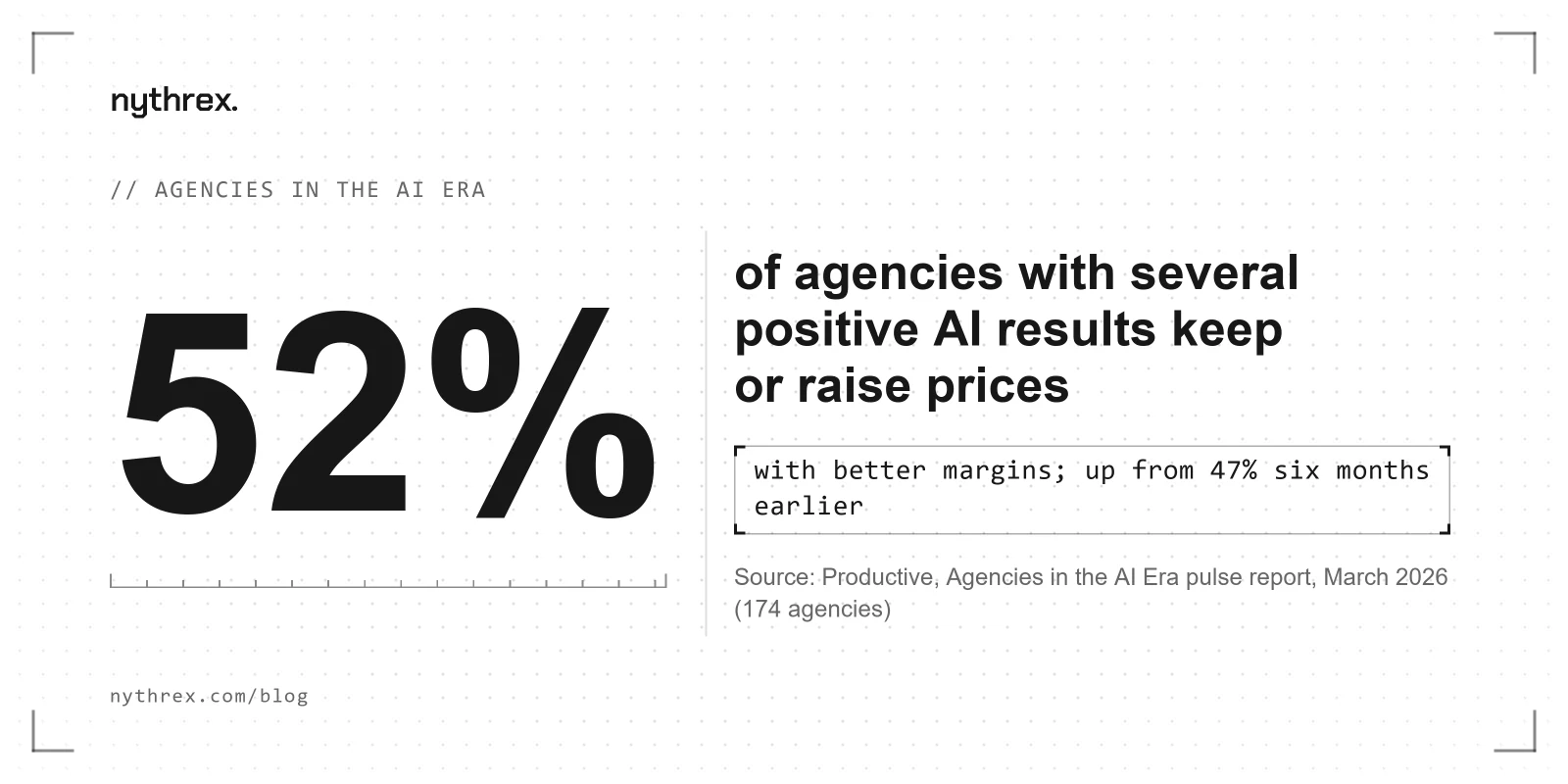
- Winners know their numbers. 52% of agencies with several positive AI results keep or raise prices with better margins.
- The blind spot is cost per client project: AI seats, agent usage, CI and cloud are rarely booked against the client they served.
The client conversation that hasn’t happened yet
The fear was that clients would read about AI productivity and demand lower rates. So far that is mostly not happening. In the first wave of Productive’s survey, coverage of the results reported that around three quarters of agencies had never been asked to cut prices because of AI. In the second wave, clients had not increased the rate of asking.
That is a window, not a guarantee. Procurement teams read the same headlines, and contracts come up for renewal. The agencies that keep their prices are the ones that can show what the work involves and what it costs. The rest are negotiating on feel.
Pricing is moving faster than measurement
The survey describes value-based billing as the preferred direction for agencies that are changing their model. It also reports a slight rise in agencies that cannot estimate AI’s impact on revenue at all. Those two findings pull against each other. Value-based and fixed-fee pricing only protect margin if you know what delivery costs you. Hourly billing hides the question, but rewards being slow.
You cannot sell outcomes if you don’t know what each outcome costs you.
Where the margin leaks
Most agencies run AI the way they run office software: a few subscriptions, a shared API key, an organisation-wide CI plan and a cloud account with several clients inside. One small consultancy in the Productive report simply claimed its AI subscription as an expense. None of that is wrong. It just makes a per-client P&L impossible.
| Cost | How it is usually booked | What a project P&L needs |
|---|---|---|
| AI seats | Per person, as overhead | Usage by the client project it served |
| Agent and API usage | One shared key, one monthly invoice | Sessions linked to the client’s repository and tasks |
| CI minutes | Organisation-wide plan | Pipeline runs per client repository |
| Cloud environments | Shared subscription, several clients | Resources grouped by client project |
| People’s time | Timesheets, often rounded | Time next to the work it produced |
What to do before the next renewal
- 1
Map every repository and board to a client
It sounds basic, but it is the step every later number depends on. Internal tools and pre-sales work get their own project. - 2
Route AI usage to projects
Where a provider supports projects or separate keys, use them per client. Where it does not, link sessions to the repository they ran in. - 3
Split cloud by client
Separate subscriptions, projects or resource groups per client make the cloud bill readable without spreadsheets. - 4
Compare cost per delivered change
Totals hide scale. Cost per change that reached production shows which clients and which kinds of work are profitable. - 5
Then choose the pricing model
With real numbers, hourly, fixed and value-based pricing become a decision, not a guess. And you can show the client evidence instead of a rate card.
Where Nythrex fits
Nythrex shows delivery cost by project: AI from Claude Code, Codex and GitHub Copilot, CI, and cloud from Azure or Google Cloud, with an optional estimate of people’s time. AI spend that has no project stays on its own line instead of disappearing into overhead. Every figure shows its basis, and access to each source is read-only.
Sources
Frequently asked questions
Are clients asking agencies for discounts because of AI?
Less than expected. In Productive’s March 2026 survey of 174 agencies, clients had not increased the rate of asking for discounts, and coverage of the first wave reported that most agencies had never been asked to cut prices because of AI.
Should agencies pass AI tool costs on to clients?
It depends on the contract. Time-and-materials contracts can list AI as a direct cost; fixed and value-based contracts include it in the price. Either way, you need to know the AI, CI and cloud cost per client project first.
How do you calculate margin per client project when the team uses AI?
Map repositories, boards and cloud resources to client projects, link AI sessions and CI runs to the repositories they ran in, add people’s time, and compare the total with what the client paid. Cost per delivered change shows which work is profitable.
Read next
- The AI bill nobody owns: seats, credits, API keys and the corporate cardAI reaches software companies through seats, usage credits, API keys and expense reports. Finance sees vendors, engineering sees tools, and nobody sees the total by product. Here is how to fix it before the next renewal.Read
- The monthly engineering report that eats a day, and why nobody trusts itThree in four engineering managers must report on team performance, and fewer than half believe their metrics reflect real value. The problem is not effort: it is numbers assembled by hand from five tools with no source behind them.Read
- Claude Code and Codex cost tracking by project and PRSee what Claude Code and Codex cost your team by project, person, pull request and period. One command per machine — no code, no prompts.Read
Stop guessing.
Start seeing.
No card and no subscription: paid plans have not launched yet.