
News · Pricing
The flat seat is over: GitHub Copilot now bills agent work by the token
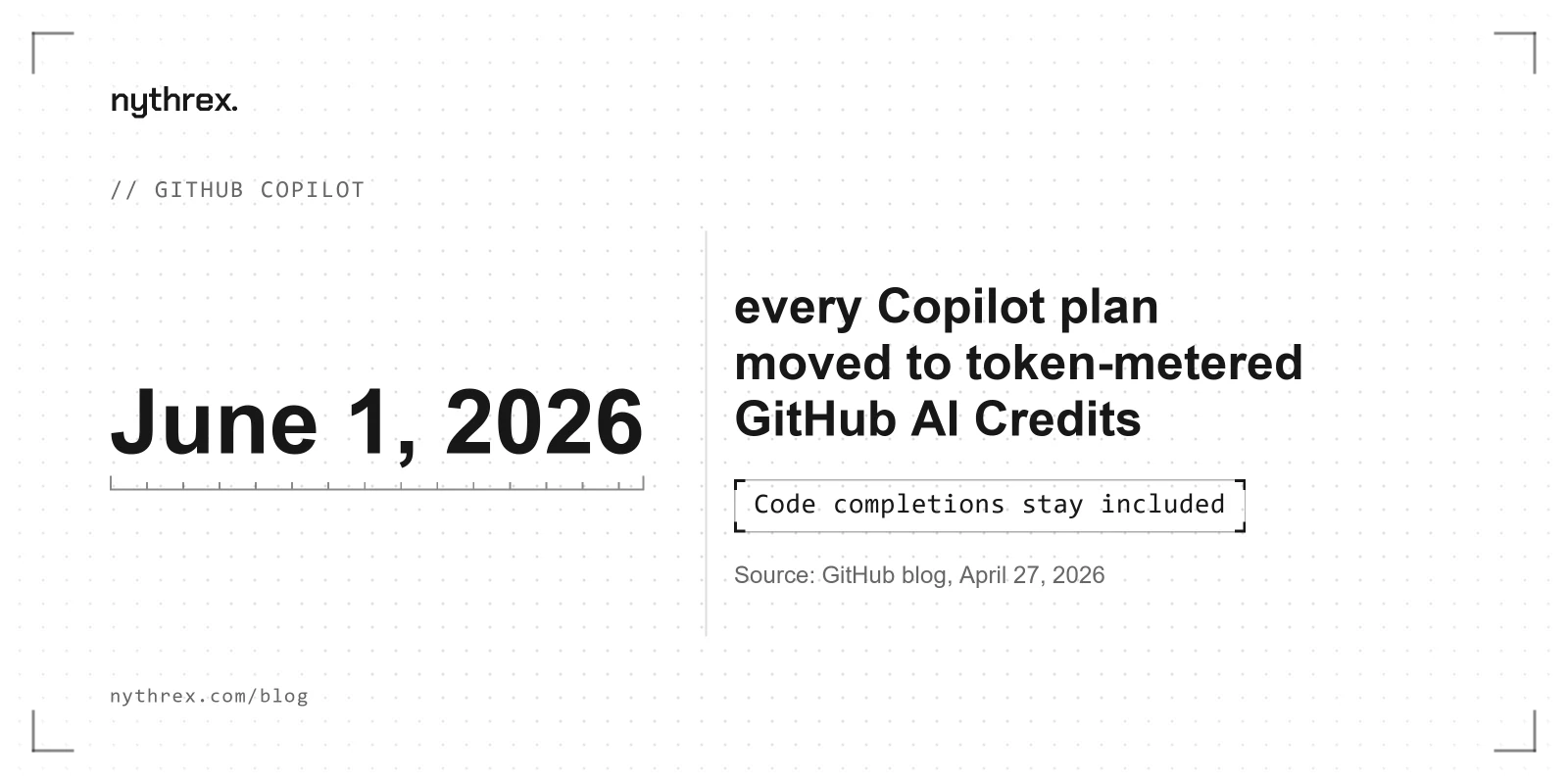
For three years, an AI coding assistant was a seat: a fixed price per developer per month. On June 1, GitHub ended that for Copilot. Every plan now comes with a monthly pot of AI Credits, and chat and agent work draws it down at the published API price of whichever model does the work. The seat still exists. What it buys is now a budget.

Nythrex team · 10/28/2026
In brief
5-minute read · Updated 28 October 2026
- The switch. GitHub announced on April 27 that AI Credits would replace Copilot’s premium requests. The change took effect on June 1, 2026.
- The meter. Usage is priced by input, output and cached tokens at each model’s published API rate. Code completions and Next Edit suggestions stay included.
- The price. Seat prices did not change. Each plan includes credits equal to its price, and admins can set budgets for the enterprise, a cost centre or a user.
- The point. Engineering leaders now manage a consumption budget, not a head count.
What changed on June 1
The old model counted premium requests, with multipliers for expensive models. The new one is simpler on paper: each request is priced by the tokens it consumes, at the API rate of the model that served it. When the included credits run out, a user can no longer fall back to a cheaper model for free. The limit is now the credit balance and whatever budget an admin has set.
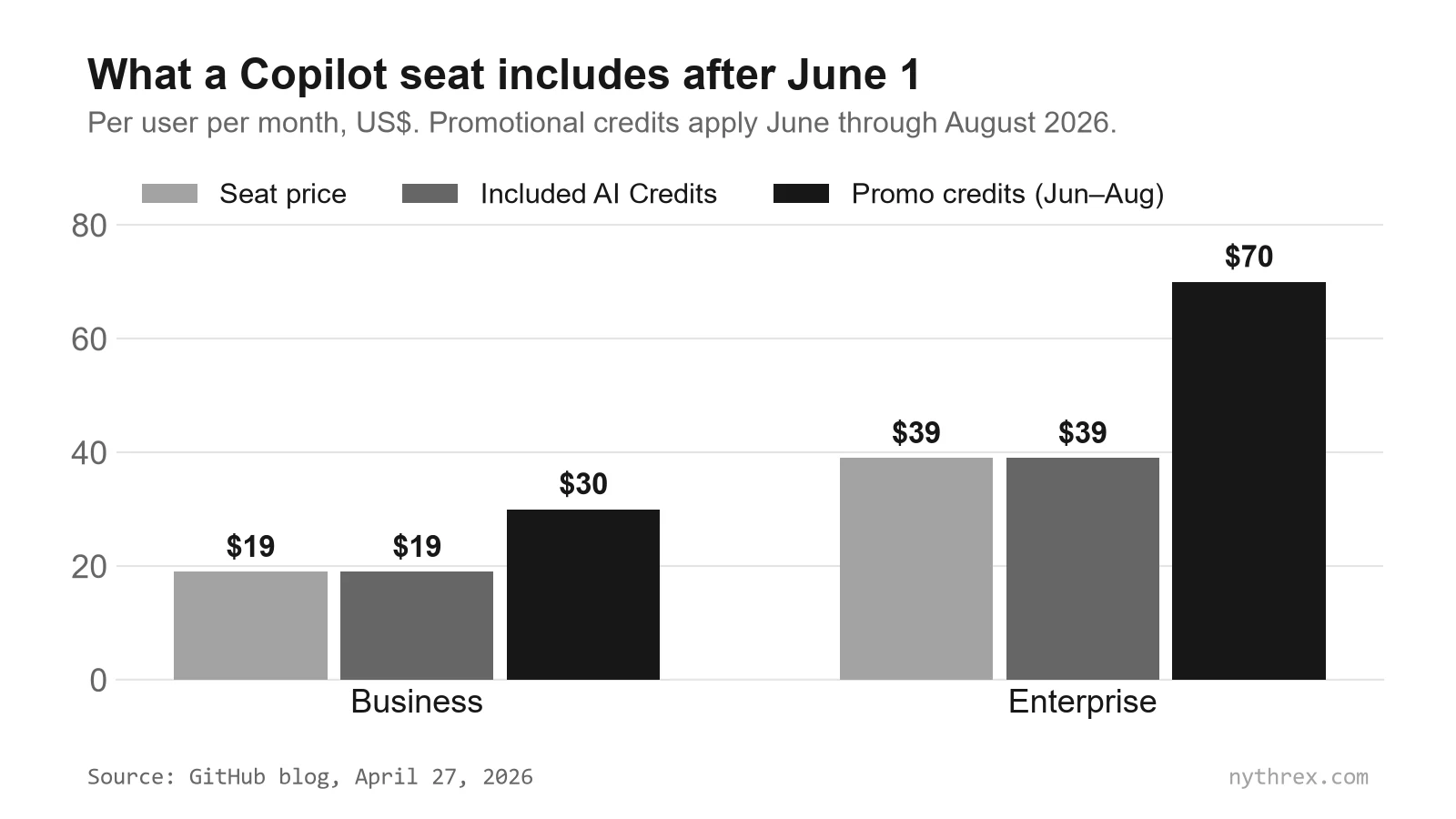
Annual Pro and Pro+ subscribers stay on premium requests until their plan ends. Existing Business and Enterprise customers received promotional credits for June through August. One detail is easy to miss: Copilot code review also consumes GitHub Actions minutes, billed at standard Actions rates. The AI bill and the CI bill are starting to overlap.
By the numbers
$19 and $39
Business and Enterprise seat prices per user per month, unchanged. Each includes the same amount in monthly AI Credits.$30 and $70
Promotional credits per user per month for existing Business and Enterprise customers, June to August 2026.3 budget levels
Enterprise, cost centre and user. Included credits can be pooled across the organisation.
The seat still exists. What it buys is now a budget.
Part of a bigger shift
GitHub is not alone. Cursor moved from request-based to credit-based pricing in 2025 and later apologised and refunded users surprised by the charges. In June 2026 it split its Teams plan into two seat types. Industry analyses now describe the major coding-agent vendors as moving from seat licences to consumption pricing, and Gartner has been cited warning that heavy agentic use could push a single developer’s bill into thousands of dollars a month.
The reason is not hard to see. A completion costs a few tokens. An agent session re-reads its growing context on every turn and can consume orders of magnitude more. A seat priced for autocomplete cannot carry an agent that works for an hour. Metering moves that risk from the vendor to the customer.
What it means for engineering leaders
- 1
Budget the work, not the head
With pooled credits, a few heavy agent users can consume what the whole team was allotted. Look at usage by project and by type of work before you look at individuals. - 2
Set budgets before the first surprise
GitHub offers budgets for the enterprise, cost centres and users. Cost centres that map to projects make the bill readable later. - 3
Watch the overlap with CI
AI code review runs on Actions minutes. A cheaper AI bill can quietly become a bigger CI bill. - 4
Tie spend to shipped changes
A credit balance tells you how much was used, not what it produced. Sessions that end without a commit and pull requests closed unmerged consume credits too.
Where Nythrex fits
Metered AI makes one question unavoidable: what did each change cost? Nythrex answers it for Claude Code and Codex today. It follows a change from task to AI session, commit, pull request, CI and deploy, and shows the basis of every figure: reported by the source, measured and priced, or estimated. A total with a missing price is marked incomplete, never zero.
Sources
Frequently asked questions
What are GitHub AI Credits?
Since June 1, 2026, GitHub AI Credits are the unit for Copilot chat and agent usage. Each request is priced by its input, output and cached tokens at the published API rate of the model used. They replaced premium requests on all plans.
Did Copilot seat prices change?
No. Business stays at $19 and Enterprise at $39 per user per month, and each plan includes the same amount in monthly AI Credits. Code completions and Next Edit suggestions do not consume credits.
How can teams control Copilot spend under usage-based billing?
Admins can set budgets for the enterprise, cost centres and individual users, pool included credits and cap extra usage. To understand the spend, tie it to projects and to the changes it produced rather than to seats.
Read next
- The CI bill in the agent era: what GitHub’s Actions pricing reset tells engineering teamsGitHub cut hosted runner prices by up to 39% in January and postponed a planned $0.002-per-minute charge on self-hosted runners. Coding agents that iterate through CI will make both decisions matter more.Read
- Your AI coding plan changed again. What does a shipped change actually cost?Five-hour windows, weekly caps and plan tiers for Claude Code and Codex keep changing. The invoice stays the same, but what it buys does not. How to compare plans by the cost of shipped work, not by the sticker price.Read
- Claude Code and Codex cost tracking by project and PRSee what Claude Code and Codex cost your team by project, person, pull request and period. One command per machine — no code, no prompts.Read
Stop guessing.
Start seeing.
No card and no subscription: paid plans have not launched yet.