
News · CI costs
The CI bill in the agent era: what GitHub’s Actions pricing reset tells engineering teams
CI minutes used to be a quiet line in the budget. In December, GitHub made them news. Hosted runners would get cheaper on January 1, and self-hosted runners, free to use since Actions launched, would carry a platform charge from March. The first change went ahead. The second was postponed within days. Meanwhile coding agents are learning to iterate by running the pipeline, which means more minutes for everyone.
Nythrex team · 10/28/2026
In brief
5-minute read · Updated 28 October 2026
- Cheaper hosted runners. On January 1, 2026, GitHub cut prices for its hosted runners by up to 39%, depending on machine size.
- A paused fee. A $0.002-per-minute charge on self-hosted runners, planned for March 1, was postponed for re-evaluation. No new date has been set.
- Public stays free. Public projects used 11.5 billion Actions minutes in 2025, worth about $184 million by GitHub’s count.
- Agents raise the stakes. Agents that iterate through CI, and AI code review that runs on Actions minutes, push usage up.
What happened
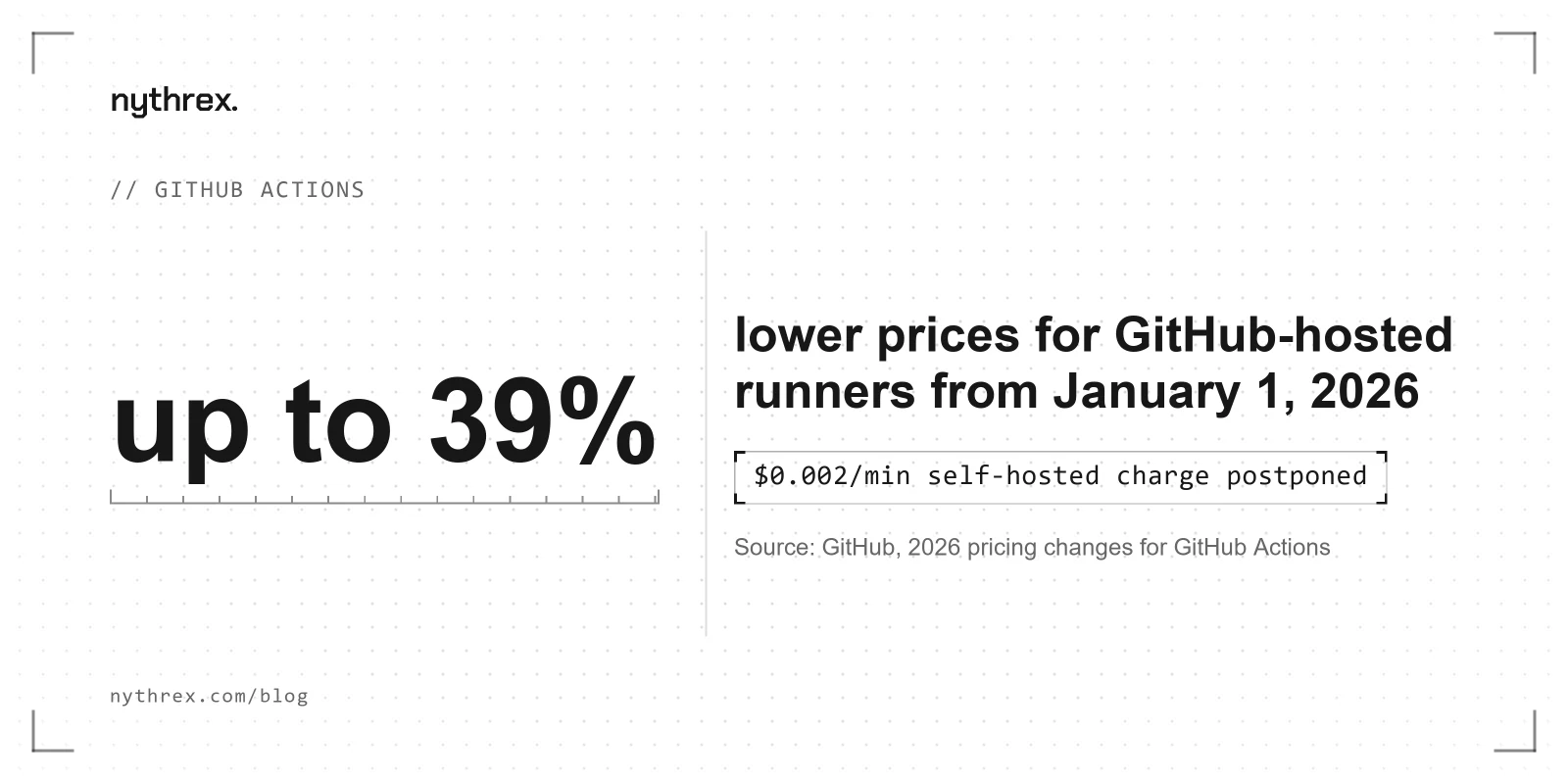
GitHub described the January change as a cut of roughly 40% across runner sizes, combined with a new cloud platform charge that is already included in the lower per-minute price. Smaller runners saw smaller reductions and larger ones bigger reductions.
The same announcement said the platform charge would also apply to self-hosted runners from March 1, at $0.002 per minute, and that self-hosted minutes would start counting against plan quotas. Teams that had moved to their own machines precisely to avoid per-minute pricing pushed back hard. GitHub postponed the change to re-evaluate its approach and has not announced a new date. It has not withdrawn the idea either.
The arithmetic of the postponed fee
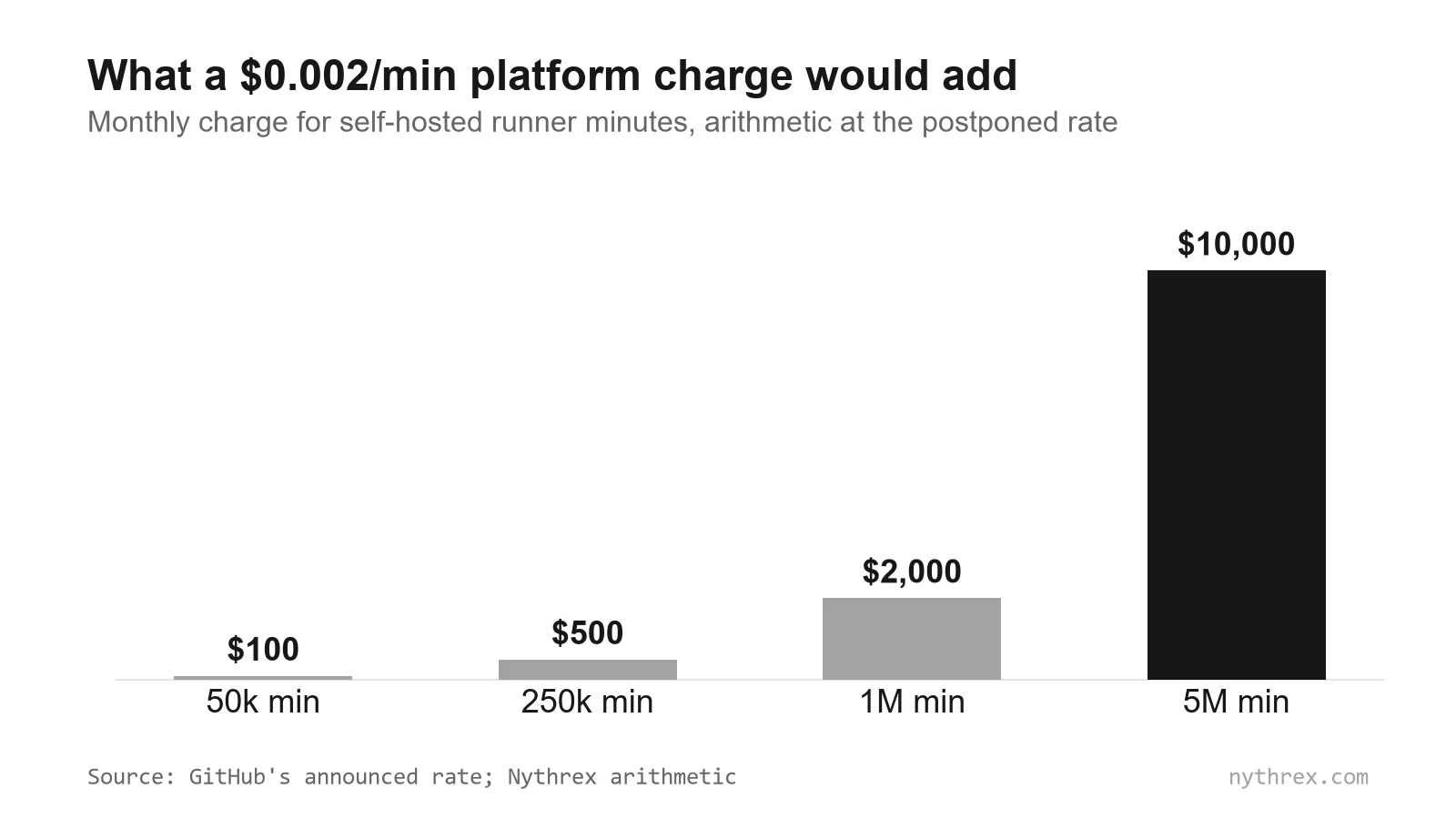
At the announced rate, a million self-hosted minutes a month would add $2,000, and five million would add $10,000. That is small next to the cost of the machines themselves. But it is a new line for teams whose whole reason for self-hosting was a CI bill that did not grow with every run.
The cheapest CI minute is the one an agent never needed to run.
Why agents change the CI equation
- Agents iterate through the pipeline. Fixing a failing build often means pushing and running CI again, sometimes many times.
- Parallel agents multiply runs. Several agents on several branches each trigger their own pipelines.
- AI review runs on CI. GitHub says Copilot code review consumes Actions minutes at standard rates.
- Failed runs ship nothing. Every red build is a cost without a result, and agents produce more of them on the way to green.
| Pattern | Why it costs | What to look at |
|---|---|---|
| Agent retry loops | Every attempt is a full pipeline run | Runs per merged pull request |
| Flaky tests | Re-runs that verify nothing new | Re-run rate by workflow |
| Parallel branches | Duplicate pipelines for competing attempts | Minutes on branches that never merged |
| Full suite on every push | Long runs for small changes | Minutes per change size |
What to do now
- 1
Measure minutes per merged change
Total minutes say little. Minutes per change that reached production show whether CI is getting more efficient. - 2
Separate failed runs
Track the share of minutes spent on runs that failed or belonged to changes that were never merged. - 3
Compare hosting on total cost
Self-hosted runners are free of GitHub minute charges today, but machines and upkeep are not. Re-check the maths when the fee returns. - 4
Cancel superseded runs
Concurrency limits and cancelling in-progress runs on new pushes are cheap wins when agents push often.
Where Nythrex fits
CI is one link in the chain Nythrex follows from AI session to production. Pipeline runs are attached to the change they verified, failed runs stay visible, and CI within included minutes is labelled as an estimate from the price list rather than shown as free.
Sources
Frequently asked questions
Did GitHub start charging for self-hosted runners in 2026?
No. GitHub announced a $0.002-per-minute platform charge for self-hosted runners from March 1, 2026, then postponed it to re-evaluate the approach. As of October 2026 no new date has been announced.
How much cheaper are GitHub-hosted runners in 2026?
Up to 39% cheaper from January 1, 2026, depending on machine size. GitHub combined a roughly 40% cut with a new cloud platform charge built into the lower rate.
Why do AI coding agents increase CI costs?
Agents often fix failing builds by pushing and re-running the pipeline, parallel agents trigger their own runs, and AI code review can consume CI minutes. Measuring minutes per merged change and separating failed runs shows where the extra cost goes.
Read next
- Assign the issue, get a pull request. What does an agent’s PR really cost?Coding agents now take an issue and return a pull request. Two new studies of tens of thousands of agent PRs show where the cost hides: review time, follow-up fixes and reverts.Read
- The flat seat is over: GitHub Copilot now bills agent work by the tokenSince June 1, 2026, every GitHub Copilot plan meters chat and agent work in AI Credits at model API rates. What changed, what it means for engineering budgets, and how to keep the bill explainable.Read
- How Nythrex works: from AI session to productionHow Nythrex links the task, AI session, commit, pull request, CI run, deployment and cloud into one unit of work with its own cost and the basis for every figure.Read
Stop guessing.
Start seeing.
No card and no subscription: paid plans have not launched yet.