
News · FinOps
98% of FinOps teams now manage AI spend. Most still can’t say what it bought
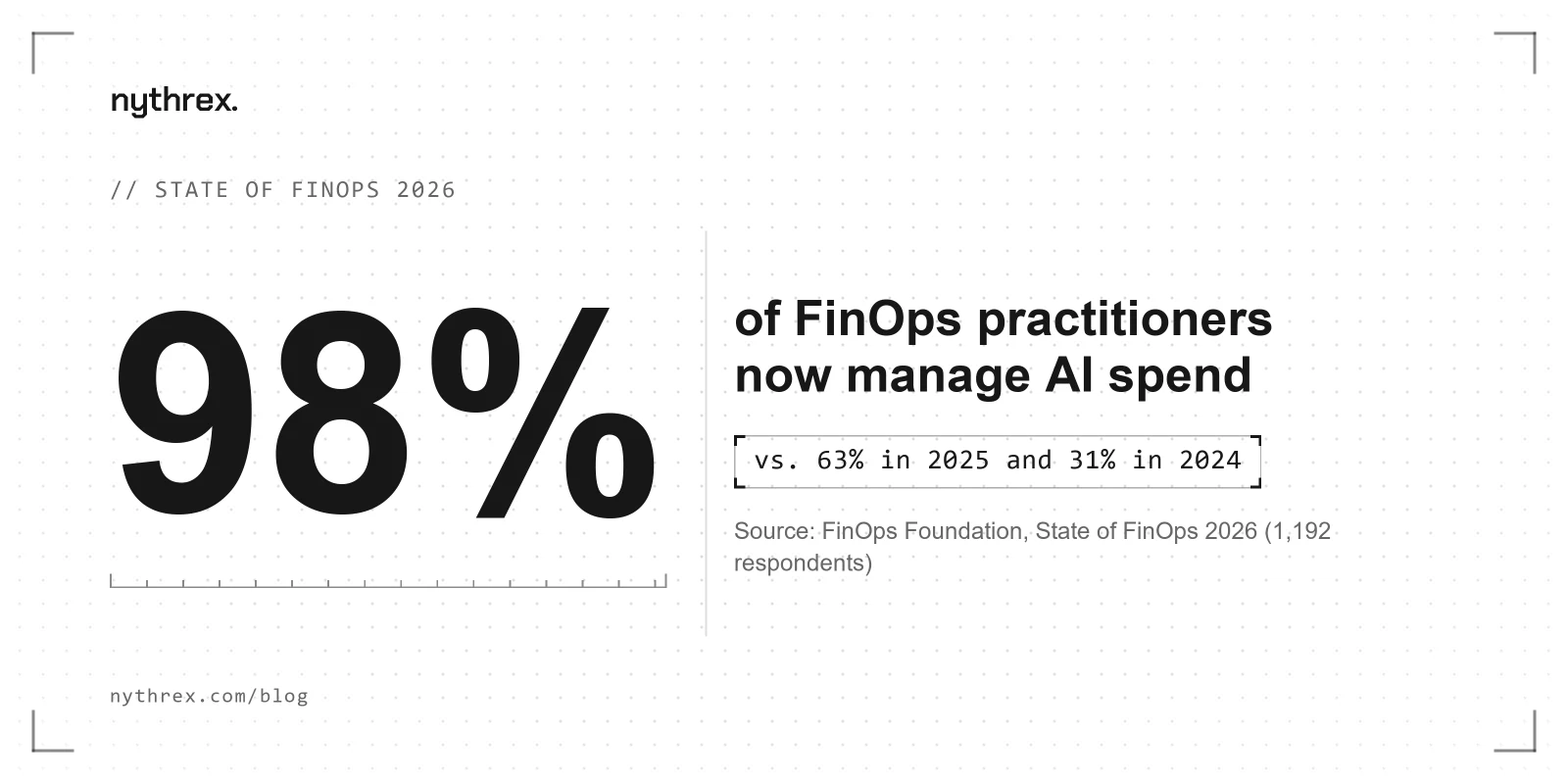
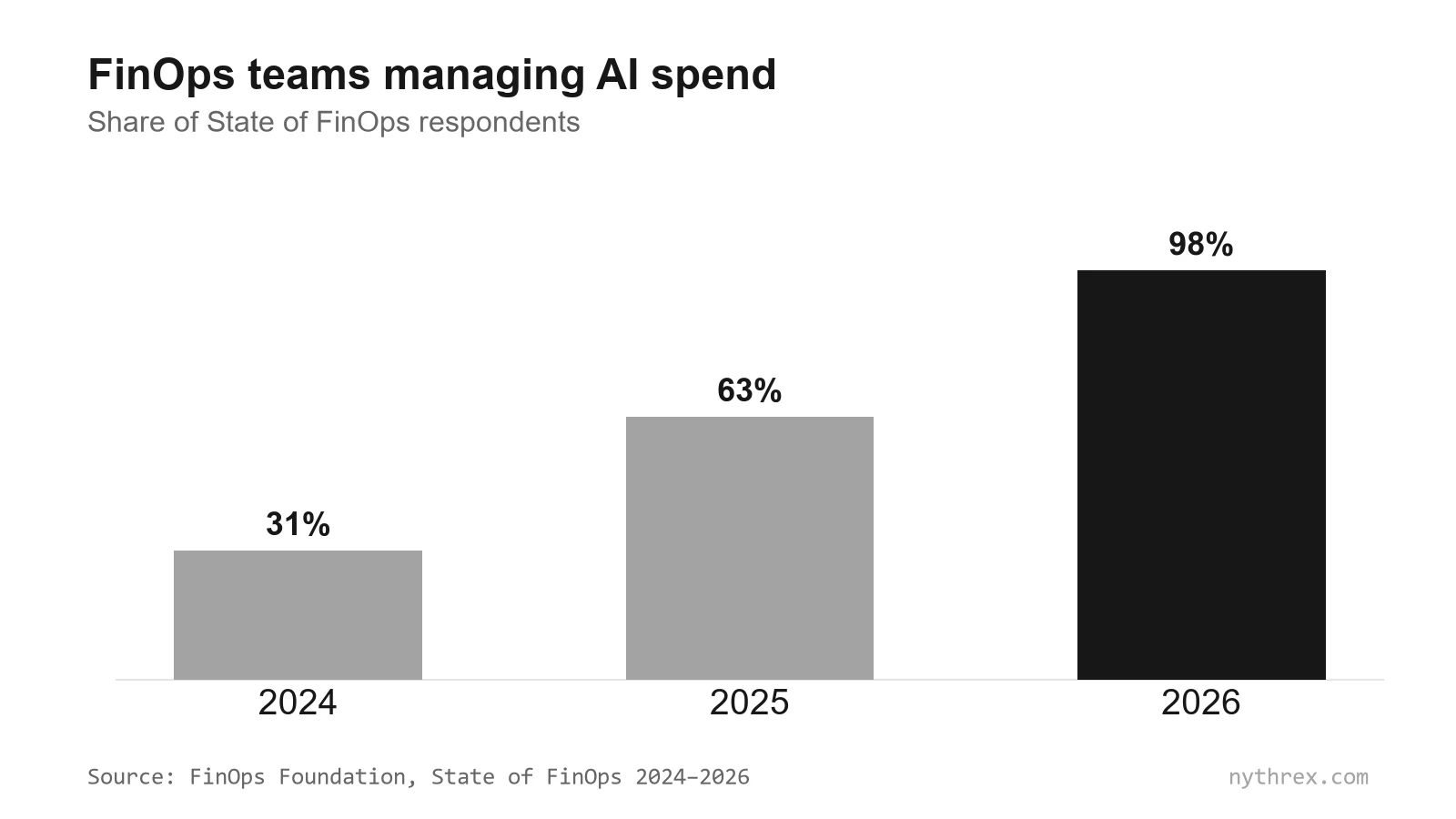
Two years ago, fewer than a third of FinOps practitioners managed AI spend. In the State of FinOps 2026, 98% do. AI has moved from an experiment on the cloud bill to the top of the FinOps agenda. The survey is frank about what has not followed: almost nobody can yet say with confidence what the money buys.
Nythrex team · 10/28/2026
In brief
6-minute read · Updated 28 October 2026
- The survey. 1,192 respondents representing more than $83 billion in annual cloud spend.
- The headline. 98% now manage AI spend, up from 63% in 2025 and 31% in 2024. FinOps for AI is the top forward-looking priority.
- The problem. The top AI challenges are visibility across different pricing models, allocating costs to business units and proving value.
- The wish list. The most requested tool capability is granular monitoring of tokens, LLM requests and GPU utilisation.
From niche to nearly universal
Few metrics in any industry survey move this fast. In 2024 AI spend was something a minority of FinOps teams touched. In 2026 it is part of almost every team’s scope, and AI cost management is the skill practitioners most want to hire or build.
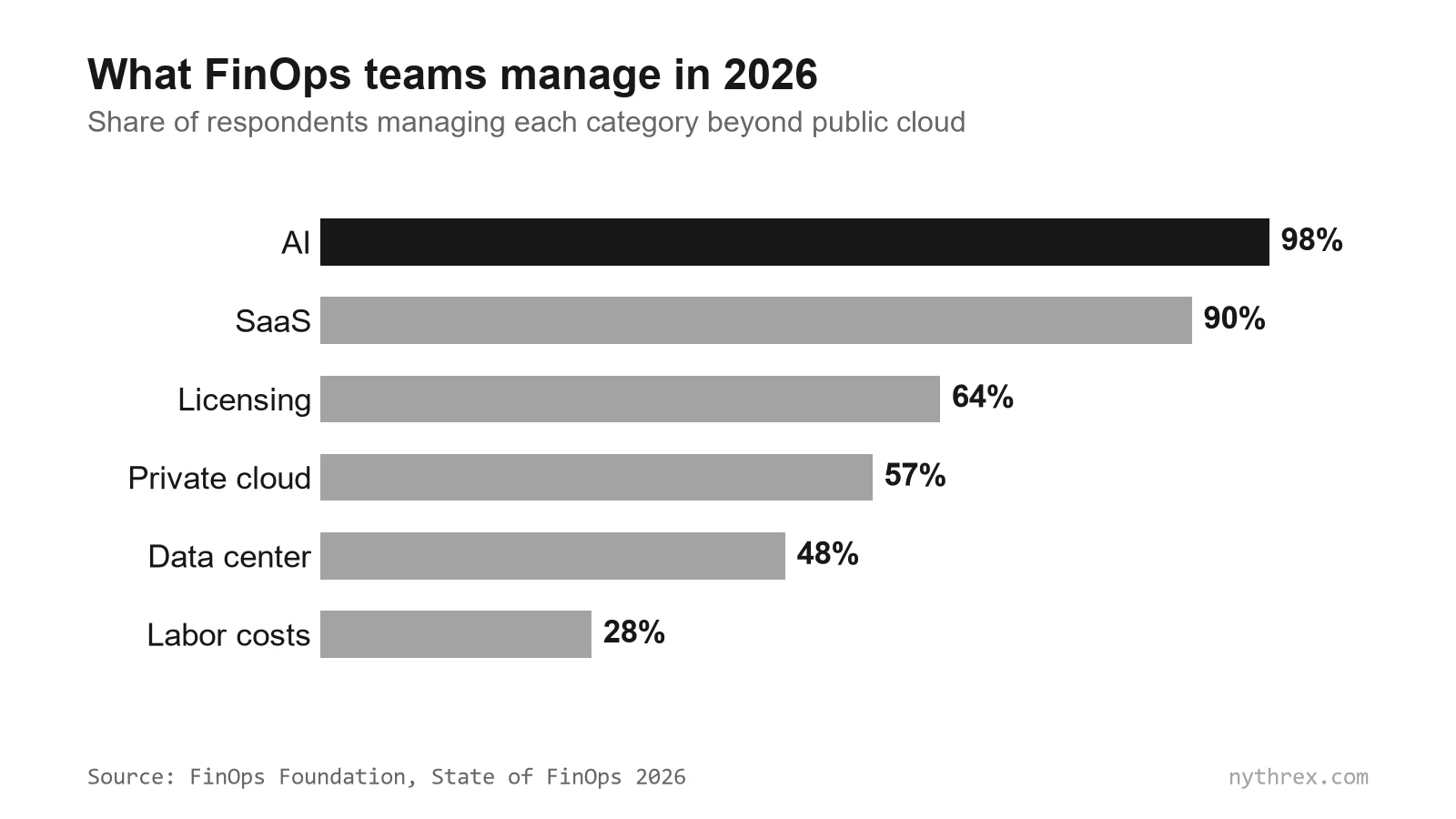
FinOps is no longer only about cloud
AI is the sharpest example of a broader expansion. FinOps teams now manage SaaS, licences, private cloud and data centres, and 28% have started to include labour costs. Most of them report to the CTO or CIO, not to finance.
78%
of FinOps teams report to the CTO or CIO. Reporting to the CFO fell to 8%.#1
FinOps for AI is the top forward-looking priority; waste reduction remains the top current one.AI workloads
are the top request for expanding FOCUS, the open billing data standard.
The question nobody can answer yet
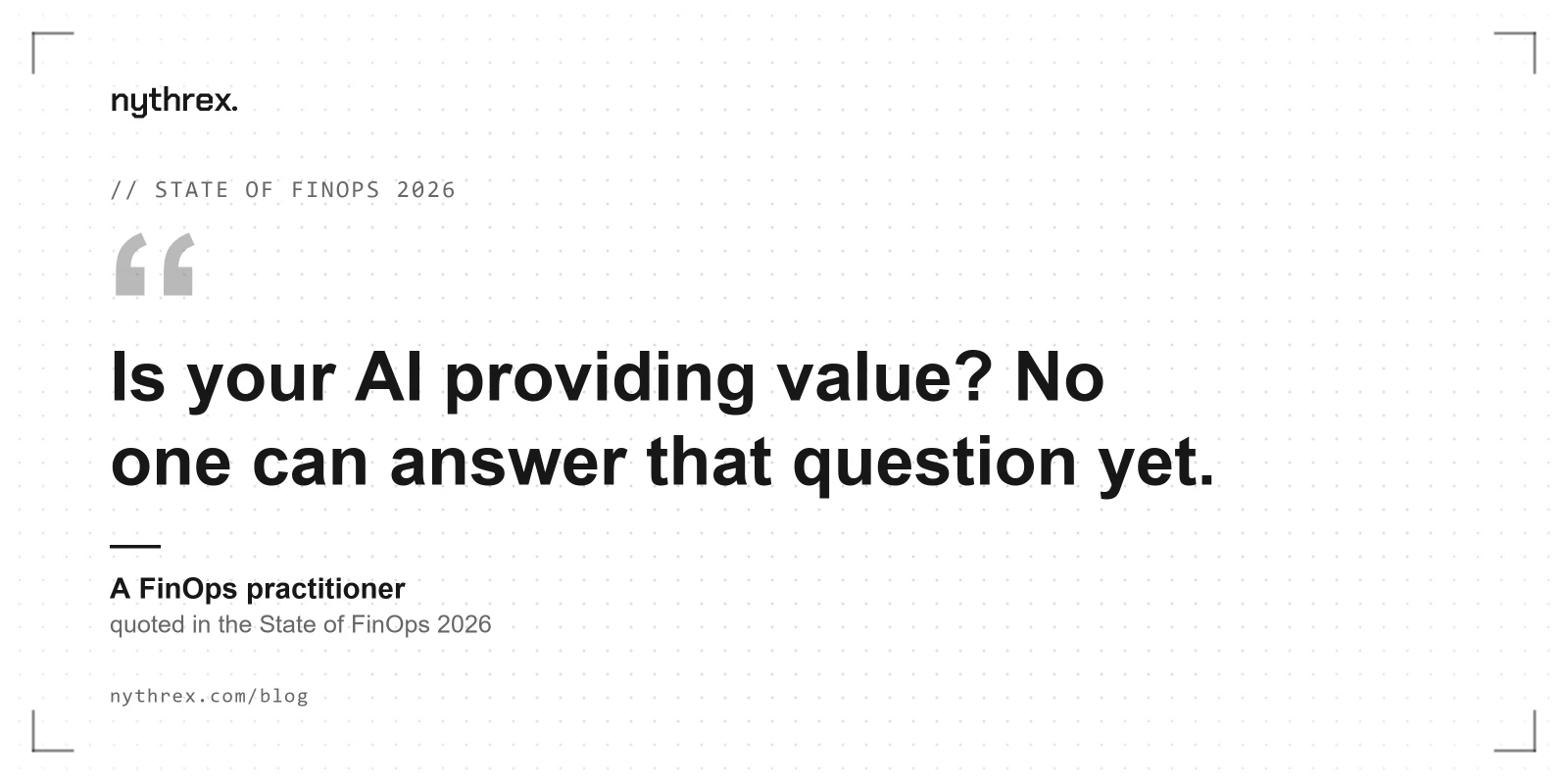
That line from a practitioner may be the most honest sentence in the report. Managing a cost and understanding it are different things. The survey’s own list of AI challenges explains why:
- Every provider prices differently. Tokens, seats, credits, GPU hours and reserved capacity do not add up on one axis.
- The bills land in different places. Cloud invoices, SaaS subscriptions, API accounts and expense reports.
- Shared pools hide who used what. Allocation to business units is the second biggest challenge.
- Outcomes live elsewhere. Value shows up in products and repositories, not on any bill.
Managing AI spend and understanding it are not the same thing.
The blind spot: AI in engineering
Much of the AI spend in a software company never touches the cloud bill. Coding assistants and agents are bought as seats, credits and API keys, often by the engineering team itself. That spend is real, growing fast and rarely tied to what it produced. In engineering, the natural unit of value is a shipped change.
| Spend | Where the bill lives | What it should be tied to |
|---|---|---|
| AI coding subscriptions | SaaS invoices, card expenses | Projects and the changes they shipped |
| Agent API usage | Model provider accounts | Sessions, pull requests and deploys |
| CI minutes | CI provider invoice | Pipelines and the pull requests they verified |
| Cloud resources | Cloud bill, often in FOCUS format | Projects and services |
A practical starting point
- 1
Inventory every AI bill
Include subscriptions and credits bought by teams, not only cloud and API accounts. - 2
Allocate by project, not by person
Projects map to business value. Individuals are the wrong unit for cost and invite surveillance. - 3
Connect spend to outcomes
For engineering, follow AI usage to the commits, pull requests and deploys it led to. - 4
Keep unknowns visible
Where a price or link is missing, mark the total incomplete instead of guessing.
Where Nythrex fits
Nythrex covers the engineering piece of FinOps for AI: the cost of every change from AI prompt to production, together with the CI and cloud of the same project. Each figure carries its basis, subscription usage is labelled as an estimate, and cloud is counted at project level rather than spread across changes.
Sources
Frequently asked questions
What share of FinOps teams manage AI spend in 2026?
According to the State of FinOps 2026, 98% of respondents manage AI spend, up from 63% in 2025 and 31% in 2024.
What is the biggest challenge in FinOps for AI?
Respondents name visibility into AI costs across different pricing models, allocating AI costs to business units and determining the value or ROI of AI.
How should engineering teams account for AI coding spend?
Inventory every AI bill including subscriptions and credits, allocate by project rather than person, connect spend to the commits, pull requests and deploys it produced, and mark totals with missing prices as incomplete.
Read next
- DORA puts a price on AI-assisted development: the J-curve, the verification tax and the real drivers of returnGoogle Cloud’s DORA team published a framework for estimating the financial return of AI in software delivery. Its message: AI amplifies the system it lands in, and the first months may cost more than they return.Read
- After tokenmaxxing: why token spend is a cost, not a productivity metricIn 2026 engineering teams started ranking engineers by how many AI tokens they burn. Then the budgets ran out. Why token consumption is an input, not an outcome, and what to measure instead.Read
- Why Nythrex: AI development costs you can explainWhat makes Nythrex different: the cost of every change from AI prompt to production, recommendations with arithmetic, unknown is never zero, no code or prompts stored.Read
Stop guessing.
Start seeing.
No card and no subscription: paid plans have not launched yet.