
Engineering culture · AI metrics
Measure AI, not the people using it
The board wants to know whether the AI budget is working. The quickest chart to produce is adoption: who uses the tools, how often, how many tokens. It looks like progress. To the team it looks like surveillance, and it quietly changes behaviour in the wrong direction. Here is what the data says and what to measure instead.
Nythrex team · 10/29/2026
In brief
6-minute read · For CTOs and engineering leads · 29 October 2026
- Developers are worried. In a Harness survey of 700 practitioners and managers, 54% of developers fear evaluations tied to their AI use.
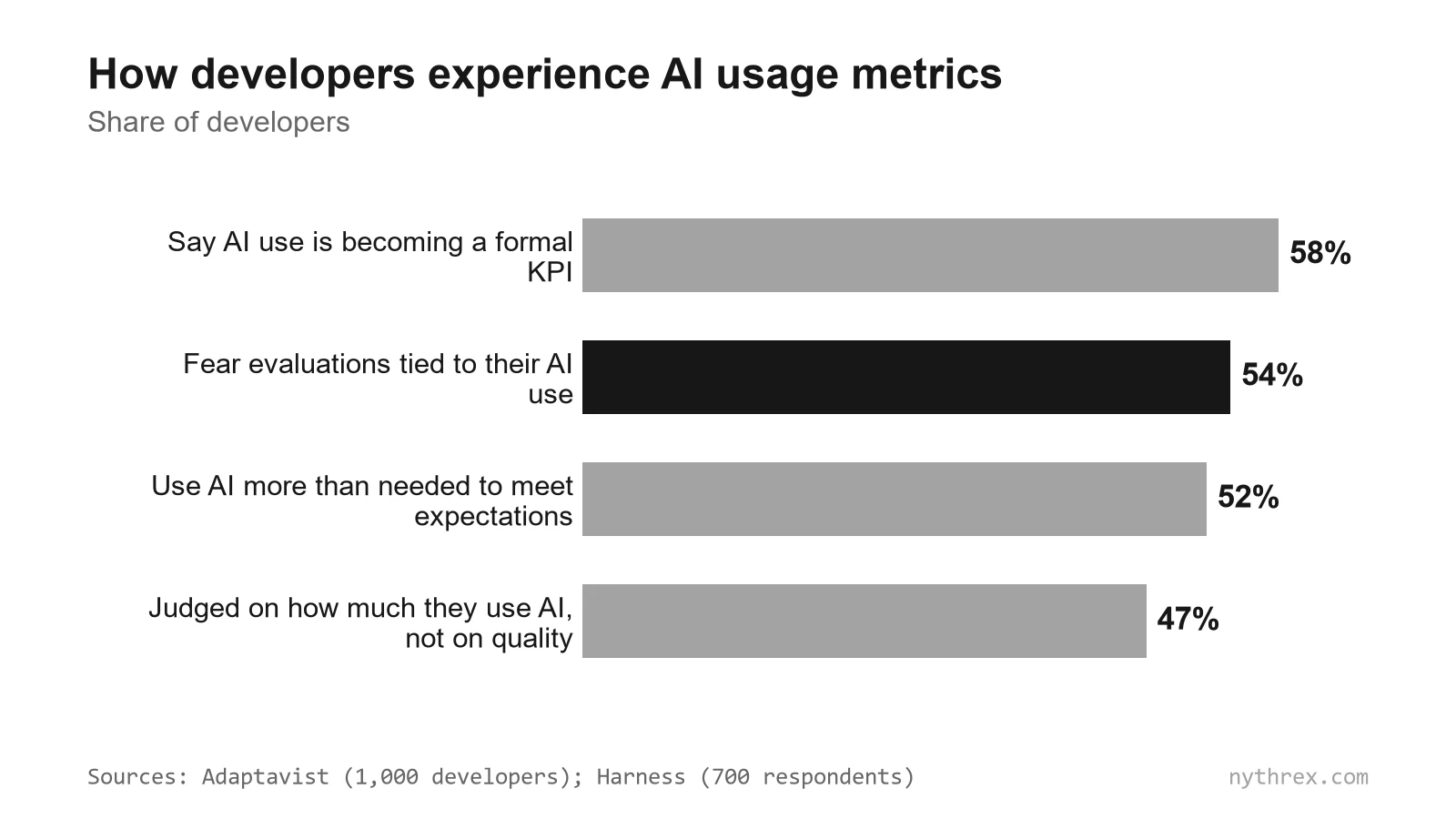
- Usage metrics distort behaviour. In an Adaptavist survey of 1,000 developers, 52% use AI more than necessary to meet expectations.
- A big company already reversed course. In September Meta stopped counting AI usage in performance reviews.
- The better unit is the change: what AI cost per shipped piece of work, by project and team.
How developers experience AI metrics
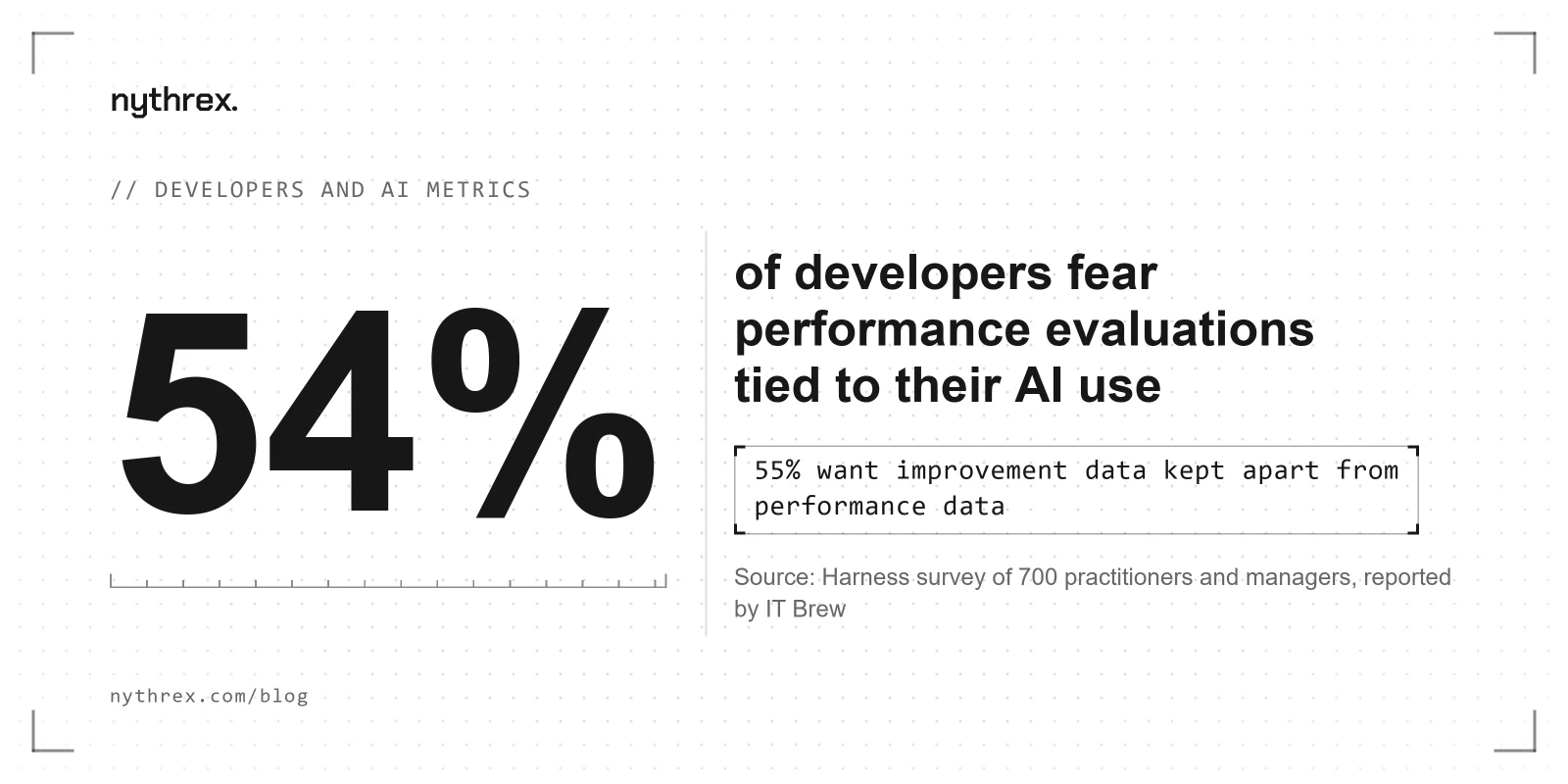
The same Harness survey found that 55% of developers want improvement data kept separate from performance data, and 49% want a say in defining the AI metrics used in evaluations. A separate Adaptavist survey of 1,000 developers in five countries adds the behavioural side.
The metric that backfired
Meta made AI use part of its review criteria, tracked through dashboards and token counters. Staff responded by running up token consumption to rank well on internal leaderboards, the practice now called tokenmaxxing. On September 8, according to an internal memo reported by The Information, Meta said AI usage would no longer factor into reviews; performance would be judged on the quality, speed and complexity of the work.
Why usage per person is the wrong unit
- It measures input, not output. Tokens and prompts say nothing about whether anything shipped.
- It gets gamed. Once usage is a target, usage goes up. So does the bill.
- It erodes trust. People who feel watched share less, experiment less and leave sooner.
- It answers the wrong question. The board asks whether AI is worth the money, not who typed the most prompts.
The question is whether AI is worth the money, not who used it most.
What to measure instead
| Instead of | Measure | Why it works |
|---|---|---|
| Tokens per developer | AI cost per shipped change, by project | Ties spend to delivered work |
| Adoption rate | Share of AI spend that ended in merged work | Shows waste without blaming anyone |
| Leaderboards | Sessions and runs that produced no result | Points at process, not people |
| Prompts per day | Lead time and change failure rate | Measures delivery, which is what AI is for |
- 1
Separate improvement from evaluation
Say in writing that AI cost and usage data is for improving the system, not for reviews. - 2
Aggregate by project and team
Report AI at the level where decisions are made: which projects, which kinds of work. - 3
Let people see their own data
Developers can learn from their own numbers without seeing colleagues by name. - 4
Define the metrics together
Half of developers want a say. Asking costs nothing and buys trust.
Where Nythrex fits
Nythrex measures AI at the level of work: the cost of each change from task to AI session, commit, pull request, CI and deploy, by project and team. It does not compare people with each other or rate productivity. A member sees only their own work and cost. From developer machines it receives request metadata only, never code or prompts.
Sources
Frequently asked questions
Should companies track developers’ AI usage in performance reviews?
Evidence suggests not. 54% of developers in a Harness survey fear such evaluations, 52% in an Adaptavist survey use AI more than necessary to meet expectations, and Meta stopped counting AI usage in reviews in September 2026.
What is tokenmaxxing?
Tokenmaxxing is running up AI token consumption to look productive on usage dashboards or leaderboards. It raises the AI bill without improving the work.
How can leaders measure the impact of AI without surveillance?
Measure at the level of work: AI cost per shipped change by project and team, the share of AI spend that ended in merged work, and delivery metrics such as lead time. Keep improvement data separate from performance reviews.
Read next
- After tokenmaxxing: why token spend is a cost, not a productivity metricIn 2026 engineering teams started ranking engineers by how many AI tokens they burn. Then the budgets ran out. Why token consumption is an input, not an outcome, and what to measure instead.Read
- The monthly engineering report that eats a day, and why nobody trusts itThree in four engineering managers must report on team performance, and fewer than half believe their metrics reflect real value. The problem is not effort: it is numbers assembled by hand from five tools with no source behind them.Read
- Nythrex security: metadata only, read-only, encryptedHow Nythrex protects data: read-only access to sources, no code or prompts stored, tokens encrypted with keys in Azure Key Vault, isolated workspaces.Read
Stop guessing.
Start seeing.
No card and no subscription: paid plans have not launched yet.